Small warehouse unit groundworks: why small isn't simple
Small industrial units aren't a shrunk-down big shed. Why the slab, drainage, and yard decide whether a small warehouse unit gets built and let on time.
By Eddie Lyons, Construction director
Generated by your browser's built-in AI. May not be fully accurate.
Small multi-let industrial units have remained relatively resilient compared with more exposed parts of the property market. Trade-counter terraces, light-industrial starter units, the 5,000 to 20,000 square foot sheds that suit a plumber’s merchant, a gym, a parcel depot, or a small manufacturer. Developers like them because they spread the risk across several tenants, and occupiers value them because good small units are difficult to find. So they are being built, and many still land on a groundworks contractor’s desk priced as if they were a smaller version of a big distribution shed.
They are not. The ground does not scale down with the floor area, and on a small unit the groundworks and external works are a bigger share of the build cost than people expect, and the part most likely to overrun, get value-engineered into trouble, or quietly fail eighteen months after handover. Get the slab, the drainage, and the yard right and the unit gets handed over clean and lets on time. Get them wrong and you are back on site with a remediation bill while the agent is fielding awkward calls from a tenant.
Small does not mean simple
The trap with a small unit is assuming that less floor area means less work in the ground. It does not, because most of the cost in a groundworks package is not the slab area itself. It is the fixed scope that has to happen regardless of how big the building is.
A 1,000 square metre unit and a 10,000 square metre unit both need a ground investigation. Both need a surface water outfall and an attenuation system sized to the planning condition. Both need a foul connection, a utility connection, a service yard, and a contractor to mobilise plant and welfare to site. None of that halves when the building halves. So the groundworks and external works cost per square metre on a small unit is routinely higher than on a large shed, sometimes significantly, and the proportion of the total build cost that sits in the ground is larger too.
Small units also tend to carry a high ratio of external works to building. A terrace of starter units needs shared yards, turning space for delivery vehicles, parking, and a service road, and all of that is groundworks. On a tight infill plot the external works can be more than half the site area. The building is the easy bit. The bit around it is where the programme and the margin actually live.
Start with the ground, not the slab
The first thing that gets cut on a small job is the ground investigation. It feels like an easy saving on a modest building, so a developer orders a couple of trial pits, or skips it and relies on a neighbouring site’s old report. That is a false economy, and it is the single most common reason small unit jobs blow their programme.
A proper ground investigation, carried out to BS 5930, gives the design team evidence for four things you cannot guess: the bearing capacity for your pad foundations, whether the slab can be ground-bearing or needs a piled solution, how aggressive the ground is to buried concrete, and whether there is contamination or made ground to deal with. Each one of those changes the price. Discovering any of them after you have mobilised changes the price by a lot more.
Ground aggressivity is the one people forget. Sulfates, acids, and sulfides in the soil and groundwater attack buried concrete, and the foundation and slab concrete has to be specified to suit. BRE Special Digest 1 sets out how to assess the aggressive chemical environment from the ground data and pick the right design sulfate class, and it matters more on brownfield and infill plots, which is exactly where small units tend to go. Get the investigation done, get the concrete specified properly off the back of it, and you avoid both over-specifying (paying for concrete you do not need) and under-specifying (concrete that degrades in the ground).
The floor slab is the job
On most small industrial units the floor slab is the largest single element of the groundworks package, the one with the tightest tolerances, and the one a tenant notices immediately if it is wrong. It deserves more thought than it usually gets.
The starting decision is ground-bearing or piled. A ground-bearing slab sits directly on a prepared and compacted sub-base and is the default where the ground investigation confirms adequate, uniform bearing. Where the ground is poor, variable, or made up, a piled slab spanning between pile caps is the safer answer, even on a small footprint, because a ground-bearing slab on inconsistent ground will settle differentially and crack. That decision comes straight out of the ground investigation, which is another reason not to skip it.
Then there is loading. Do not assume a small unit means light loads. Tenants fit racking, mezzanines, and forklift trucks into small units all the time, and a leg load from a tall racking post is a serious point load. The industry reference here is the Concrete Society’s Technical Report 34, the design and construction guide for concrete industrial ground floors. TR34 covers floor loadings from racking and mezzanines, surface regularity, joint layout, and the move from steel mesh to steel-fibre reinforcement. If a slab is designed without knowing how the unit will be used, it gets designed for the wrong thing.
The specification on a typical industrial ground-bearing slab runs along these lines:
- Concrete: C32/40 is the usual general-purpose grade, specified to BS 8500 with the exposure and sulfate classes confirmed from the ground data
- Thickness: typically 150mm to 200mm depending on the loading, with thicker construction where heavy racking or HGV traffic is expected
- Reinforcement: A393 mesh, or increasingly steel fibre, which lets you extend joint spacing and reduce the number of joints
- Finish: power-floated to a defined flatness, with TR34 free-movement classification (FM2 is the common general warehouse standard) so racking and forklifts run true
- Joints: minimised and properly detailed, because every joint is a maintenance point and a place a slab can fail
The slab is also the element most likely to go wrong, and it is brutally expensive to fix once the steel frame and cladding are up over it. Curling at the joints, random cracking, surface dusting, and ponding from poor falls are all defects that trace back to the slab, and you cannot easily lift and relay a floor inside a finished building. This is not the place to value-engineer.
Drainage and the planning condition that bites
Surface water drainage is where a lot of small unit schemes come unstuck, because the planning condition is the same whether the building is large or small. You cannot just connect a new roof and yard to the nearest drain and let the water go.
In England, sustainable drainage is required through the planning system rather than through a separate approval regime: Schedule 3 of the Flood and Water Management Act 2010 has never been commenced here, so the controls come via chapter 14 of the National Planning Policy Framework and the national standards for sustainable drainage systems, with the lead local flood authority as a statutory consultee on major applications. In practice that means the discharge rate off your site is restricted, usually back towards the greenfield runoff rate, and you have to store the difference on site and let it out slowly.
That storage is real groundworks: attenuation tanks or geocellular crates buried under the yard, a flow control device, and the design has to account for a one-in-100-year storm plus a climate change allowance set out in the Environment Agency’s guidance. Where the ground percolates well, some or all of that can be handled by infiltration instead, using soakaways designed to BRE Digest 365, but that depends on a percolation test and a water table that cooperates. Either way it has to be designed early and it has to be in the price.
The rest of the drainage package is the bread and butter, but it still has to be right:
- Foul drainage connected to the public sewer, designed and laid to Approved Document H
- Yard falls set so water runs to the drainage channels and gullies rather than ponding, which means the slab and hardstanding levels are a drainage design decision, not a finishing afterthought (our drainage gradients calculator covers the minimum falls)
- Interceptors where the yard takes vehicles, so fuel, oil, and silt are separated before the water reaches the system
- Service ducting for the incoming utilities, coordinated with the drainage runs so the trenches do not clash
The yard is not an afterthought
The service yard around a small unit is the part that gets cut to make the numbers work, and it is the part that fails first. A small unit still takes delivery vans, transit-sized vehicles, and the occasional rigid lorry reversing onto a loading door, and that traffic is concentrated on a small area of hardstanding. A “bit of tarmac” laid on an inadequate sub-base will rut, pothole, and pond within a couple of winters, and then the tenant is complaining and the developer is paying to relay it.
The yard pavement has to be designed for the vehicles that will actually use it, not the ones the budget would prefer. That means a properly engineered build-up, a flexible or rigid pavement chosen for the loading, a compacted sub-base over a sound formation, and falls that drain it. Heavy turning and reversing areas in particular take a hammering and often justify a rigid concrete pavement rather than flexible blacktop. Skimping on the yard is the most common false economy on a small unit, because the saving is visible on day one and the cost lands two winters later.
Brownfield infill: the small-plot trap
Small units get squeezed onto the plots nobody else wanted: corners of older estates, former yards, demolished sites, leftover slivers between existing buildings. That land is rarely clean. Expect old foundations and slabs, buried services that are not on any drawing, redundant drainage, contamination, and made ground that has to be either dug out or engineered to take the new build.
This is where the ground investigation earns its money again, because the cost of removing obstructions, disposing of contaminated material to a licensed facility, and importing or engineering fill can dwarf the rest of the groundworks. Muckaway and disposal on a contaminated infill plot is one of the biggest swing items in the whole package, and it is almost impossible to price honestly without knowing what is down there. A balanced cut and fill exercise can keep some of that material on site rather than carting it away, but only if the investigation tells you what you are working with.
Programme: groundworks sets the pace
On a small unit the groundworks are the front of the critical path, and almost everything else waits on them. The steel frame cannot start until the pad foundations are in and cured. The cladding waits on the frame. Practical completion, and therefore the date the unit can be marketed and let, is downstream of work that happens in the first weeks of the job, in the ground, often in poor weather, on a tight plot with nowhere to store materials.
That is the real reason small unit groundworks need an experienced contractor rather than the cheapest price. The sequencing on a constrained site, the coordination between drainage, foundations, slab, and incoming services, and the weather risk on the early earthworks all have to be managed, and a slip in the first month pushes the letting date back by more than the time lost. Programme certainty is worth more to a speculative developer than a small saving on rates, because an empty unit costs more in lost rent than the groundworks contractor ever saved them.
Where developers cut, and pay for it later
If you take one thing from this, take the short list of where small unit schemes go wrong, because it is the same list every time:
- Skipping or skimping the ground investigation, then meeting the made ground, the obstructions, or the aggressive ground halfway through the dig
- Value-engineering the slab specification without knowing the tenant’s loading, and ending up with curling, cracking, or a floor that cannot take the racking
- Treating the SuDS condition as paperwork, then discovering late that the attenuation and flow control are a substantial buried structure that should have been priced from the start
- Undersizing the yard pavement, which saves money visibly on day one and costs more two winters later when it has to be relaid
None of these are exotic. They are the predictable result of pricing a small unit as a small job rather than a complete civil engineering package that happens to sit under a small building.
Building small units?
If you are a developer, main contractor, or management company building small or multi-let industrial units, the groundworks deserve the same rigour as a large shed, because the risks are the same and the cost per square metre is often higher. We deliver complete external works packages for warehouse and multi-unit industrial estates under a single point of responsibility, from site strip to the final kerb line, with the programme certainty and clean handovers that let units get marketed and occupied on schedule.
Get in touch to talk through a scheme. We will tell you honestly where the risk sits in the ground before you commit to a programme.
Rospower Projects is a specialist groundworks and civil engineering contractor working across the South East and the wider UK, with over 35 years of experience delivering external works packages for industrial, warehouse, and commercial developments. Contact us to discuss your project.
Related articles
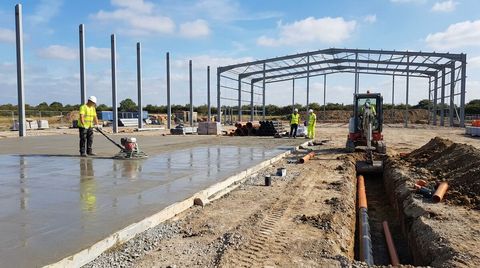
How long do warehouse groundworks take?
A realistic, stage-by-stage programme for warehouse groundworks, with typical durations and the ground, drainage and weather risks that move the date.
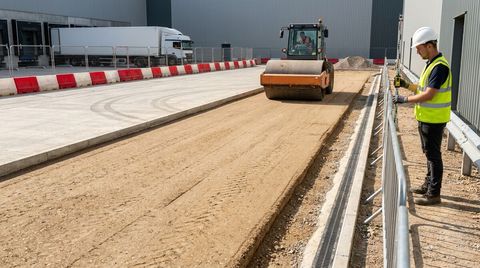
HGV yard compaction records: prove each layer before surfacing
What an HGV yard compaction record should capture before each layer is covered, from formation approval and material traceability to test locations.
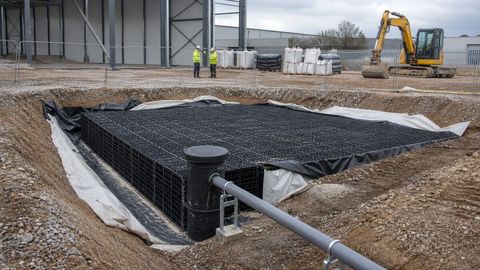
Warehouse SuDS and drainage: what planning requires in England
What England's planning system asks of warehouse surface water drainage: discharge hierarchy, runoff limits, attenuation storage and maintenance.