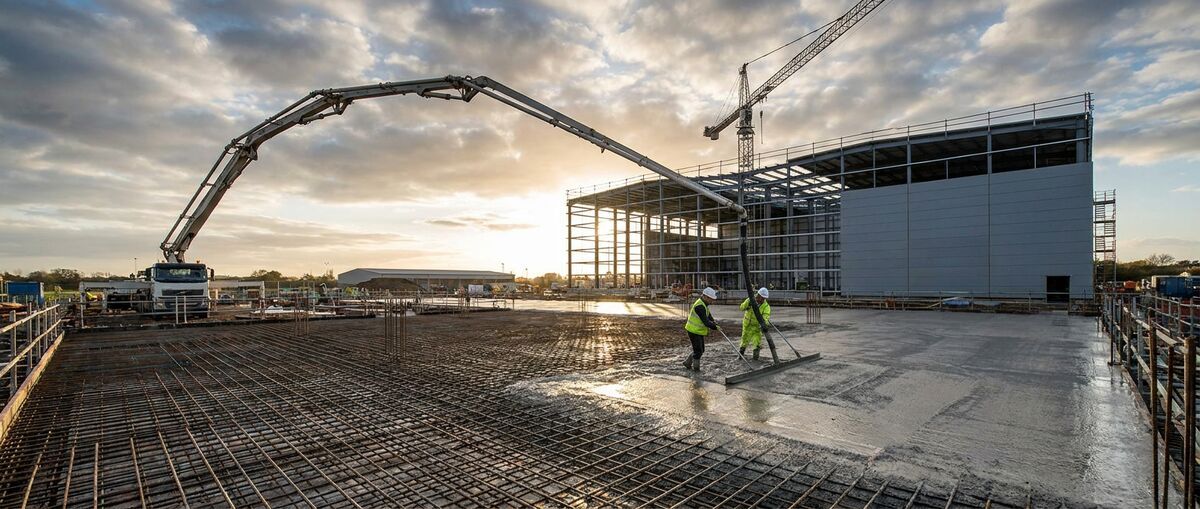
Data centre civil engineering & groundworks
Groundworks, earthworks, drainage, structural slabs, and NERS accredited substation civils for UK data centre and AI infrastructure projects, delivered as a single coordinated subcontract package.
- Enabling works & site preparation for data centre platforms
- Bulk earthworks, cut and fill & engineered formations
- Reinforced concrete raft & equipment foundation slabs
- Surface water drainage, SuDS & attenuation packages
- NERS accredited substation civils & HV cable trenching
- Security perimeter, hardstanding & access road construction
Generated by your browser's built-in AI. May not be fully accurate.
Data centre civil engineering & groundworks contractor
Rospower is a civil engineering and groundworks contractor delivering the enabling works, earthworks, foundations, drainage, and utilities civils that get UK data centre and AI infrastructure sites out of the ground. We work as a specialist subcontractor to main contractors, developers, and operators, taking single-package responsibility for the civil scope from site strip to the point where the building, mechanical, and electrical packages take over.
UK government policy now links data centre delivery to AI Growth Zones, the UK Compute Roadmap, and practical barriers around power and planning. On site, that turns into civil engineering work: power routes, substation compounds, water and cooling infrastructure, heavy foundations, and abnormal-load access all need to be evidenced and built before the data hall can follow. With over 35 years of civil engineering experience and NERS accreditation held in partnership with UK Power Connections, we are set up to deliver the groundworks, drainage, and substation civils that sit underneath data centre schemes.
Not sure how ready your site is yet? Run our free data centre site readiness checker to test the power, planning, water, ground, access, and resilience evidence before the civil scope is locked.
Enabling works and site preparation
- Site clearance and enabling works: Vegetation clearance, demolition coordination, obstruction removal, and brownfield remediation to make the site safe and workable before bulk earthworks begin
- Bulk earthworks and cut and fill: Large-scale muck shift, engineered fill, and cut and fill balancing to form the data hall and plant platforms to level and tolerance, with compaction testing and formation preparation
- Ground investigation coordination: Integration of intrusive ground investigation, contamination, and groundwater findings into the earthworks and foundation strategy, so layout changes do not derail the programme
- Piling mats and working platforms: Engineered piling mats and crane platforms designed, installed, and maintained around BRE BR 470 and FPS working platform guidance where heavy tracked plant is required
Foundations and structural concrete
- Reinforced concrete raft and slab foundations: Heavy raft foundations and ground-bearing slabs for data halls, designed for high static and equipment loads, with reinforcement fixing and large-pour logistics
- Equipment and plant bases: Reinforced concrete bases and plinths for transformers, switchgear, standby generators, chillers, and cooling plant, coordinated with the electrical and mechanical packages
- Pile caps and ground beams: Pile caps, ground beams, and transfer structures where ground conditions or loadings require a piled solution, integrated with surrounding groundworks
- Retaining structures and level changes: Reinforced concrete retaining walls and engineered slopes for sites with significant level differences or split-level plant yards
Drainage, SuDS and below-ground services
- Surface water drainage and attenuation: Complete surface water systems for large roof and yard areas, including carrier drains, attenuation tanks, geocellular crates, and flow control to meet planning discharge rates
- SuDS and exceedance routes: Sustainable drainage systems, permeable areas, swales, and designed exceedance routes that satisfy planning and resilience requirements without clashing with power or security layouts
- Foul and process drainage: Foul and process drainage with connections to adopted sewers, including Section 104 (Water Industry Act 1991) adoptable infrastructure where required
- Service ducting and multi-utility trenching: Coordinated trenching for power, water, fibre, and telecoms, sequenced with the substation and HV works so routes do not conflict
Substation civils and HV cable routes
- NERS accredited connection works: Through NERS accreditation held in partnership with UK Power Connections, we deliver contestable LV and HV connection civils with an audited route to network adoption
- Substation compounds: Transformer bases, switchgear plinths, bunding, drainage, fencing, and access for primary and on-site substation compounds
- HV cable trenching and ducting: Cable trenches, duct banks, draw pits, joint bays, and reinstatement for high-voltage routes that often run well outside the building footprint
- Reinstatement and Section 50: Highway works and Section 50 (New Roads and Street Works Act 1991) reinstatement for connections that cross the public highway
Access, hardstanding and security civils
- Abnormal-load access and haul routes: Temporary and permanent access designed for transformers, generators, switchgear, and modular plant, including swept-path checks, crane pads, and laydown areas
- Estate roads and heavy-duty hardstanding: Internal road construction, service yards, and heavy-duty hardstanding for plant, deliveries, and emergency access, built for high axle loads
- Security perimeter civils: Foundations for perimeter fencing, hostile vehicle mitigation, gatehouses, CCTV columns, and lighting, coordinated with drainage and power from the start
- External works and reinstatement: Kerbing, surfacing, line marking, landscaping ducting, and final reinstatement to leave a clean, secure, operational site
What civil works does a data centre need?
A data centre needs enabling works and bulk earthworks to form the platform, heavy reinforced concrete raft and slab foundations for the data hall, equipment bases for transformers and cooling plant, large surface water drainage and SuDS attenuation, substation compounds with HV cable trenching, abnormal-load access and hardstanding, and security perimeter civils. On most schemes this civil scope is delivered first and controls the overall programme.
Do you work as a data centre groundworks subcontractor?
Yes. Rospower works as a specialist groundworks and civils subcontractor to main contractors, developers, and data centre operators, as well as directly for clients on enabling works packages. We take single-package responsibility for the civil scope, which reduces interface risk and gives one accountable contractor from site strip through to handover of the building and M&E packages.
Why is the substation and power civils scope so important?
Data centre programmes are usually driven by power. The substation compounds, transformer and switchgear bases, and high-voltage cable routes often sit outside the main building footprint and need their own land, easements, and programme. Our NERS accredited utility capability, held in partnership with UK Power Connections, helps move the contestable connection civils through an audited delivery route and lets the power infrastructure progress in parallel with the building groundworks.
Why operators and main contractors choose Rospower
- Single-package accountability: One civils subcontractor from enabling works to external works completion, reducing interface risk and simplifying programme management
- NERS route: NERS accredited substation and HV cable civils delivered through the UK Power Connections partnership, reducing a common data centre programme risk
- Programme certainty: Experience on power, utility, and heavy industrial schemes where the civil works set the critical path
- Established delivery: 35+ years of trading and Constructionline Silver accreditation for confidence on long-duration projects
- Scalable delivery: A core team supplemented with vetted, CSCS-carded labour and plant to match the scale and pace of data centre programmes