UK's largest solar farm approved: what 800MW of groundworks looks like
The 800MW Springwell Solar Farm just got consent. What civil engineering contractors actually build on a project this size: piling to cable trenching.
By Eddie Lyons, Construction director
Generated by your browser's built-in AI. May not be fully accurate.
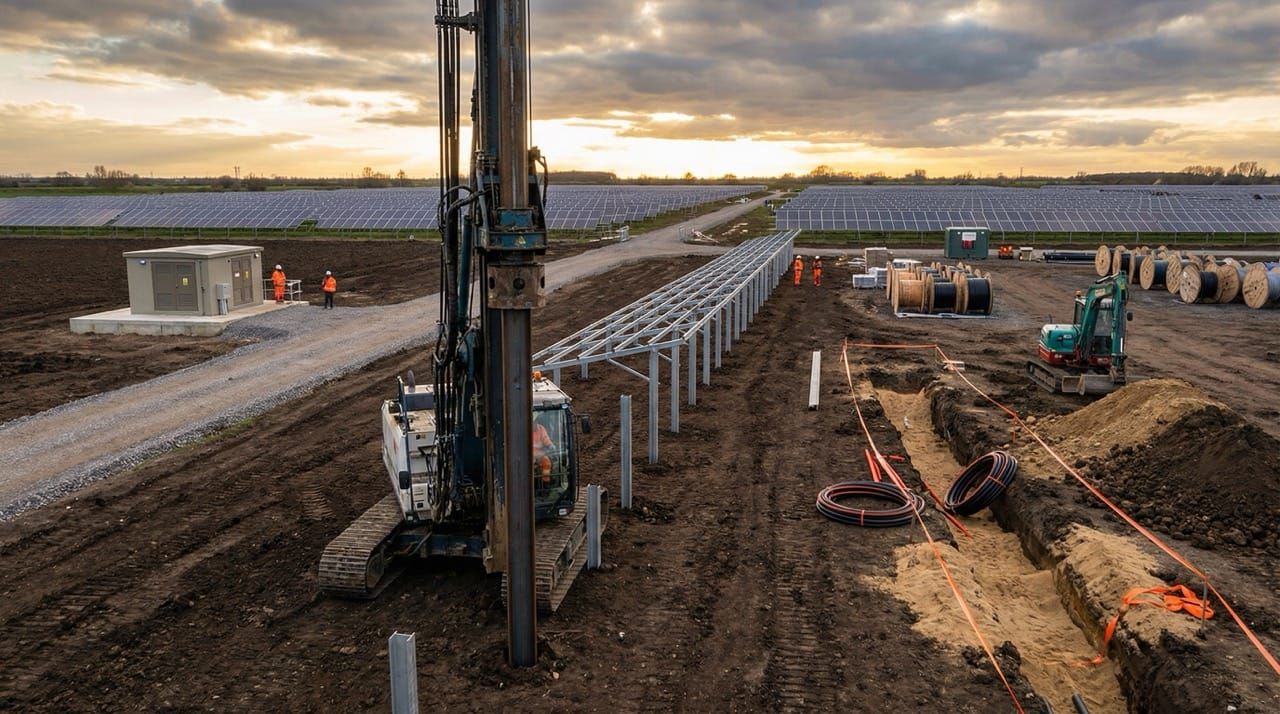
On 8 April 2026, the Secretary of State for Energy Security and Net Zero granted development consent for the Springwell Solar Farm. At 800MW, it becomes the largest power-producing solar farm approved in the UK. The project is a joint venture between EDF Renewables and Luminous Energy, sited across agricultural land in Lincolnshire.
The press coverage focuses on the headline number. 800MW. Enough to power over 180,000 homes, roughly half of Lincolnshire’s housing. A significant step toward the government’s clean energy targets.
The physical work required to build it rarely makes the press releases. Dirt, steel, cable, concrete. The civil engineering scope behind Springwell runs to years of continuous earthworks, piling, cable trenching, and compound construction before the first panel generates a watt.
Putting 800MW in perspective
If you’ve worked on a 50MW solar farm, you know it’s a significant project. Multiple fields, months of groundworks, thousands of pile positions. Springwell is sixteen times that capacity.
Here’s what 800MW translates to in physical terms:
- Site area: approximately 1,100 hectares of solar panel coverage, plus buffer land, landscaping corridors, and ecological mitigation zones. To put that in context, 1,100 hectares is roughly 2,700 acres, or about 1,500 football pitches.
- Panel count: at current module efficiencies (typically 550-600W per panel), you’re looking at roughly 1.4 to 1.6 million individual solar panels across the site.
- Internal cable trench: a project of this scale typically requires between 200km and 400km of cable trenching for string cables, collector cables, and HV export cables. That’s a lot of 600mm-deep trenches.
- Access tracks: tens of kilometres of aggregate tracks for construction access and long-term maintenance vehicle routes.
- Substation compounds: multiple onsite substations collecting power from different zones, plus battery energy storage system (BESS) compounds.
- Environmental works: the DCO documents for Springwell reference over 15km of new hedgerow planting, 12km of new or improved public footpaths, and a community growing area.
- Battery storage: an integrated BESS to store and dispatch electricity, adding further civil engineering scope for compound construction, earthing, and fire safety infrastructure.
Each one of those bullet points represents months of work for civil engineering teams. The earthworks and civils package on a project like this will involve hundreds of workers, dozens of pieces of plant, and a programme measured in years, not months.
Springwell is the 25th nationally significant clean energy project approved since July 2024, one more point on a growing consent pipeline.
The civil engineering scope
A finished solar farm is rows of panels in a field. The two to three years of civil engineering that come before and alongside panel installation never appear in the finished view.
The groundworks and civil engineering package on a utility-scale solar farm breaks down into several major work streams.
Site preparation and earthworks
Before a single pile goes into the ground, the site needs preparing. On 1,100+ hectares of Lincolnshire farmland, that’s a significant earthworks operation.
Topsoil strip and storage. The entire panel footprint needs the topsoil stripped and stored for reinstatement. On agricultural land, topsoil is typically 200-300mm deep. Across 1,100 hectares, that’s between 2.2 million and 3.3 million cubic metres of topsoil to strip, cart, and stockpile.
The stockpiles need managing correctly. Maximum 3m high for topsoil to prevent anaerobic conditions killing the soil biology. Subsoil stockpiles can go higher, to 5m, but the two must never be mixed. All stockpiles need seeding or covering to prevent wind and water erosion, and they need positioning where they won’t obstruct site drainage or future access routes. On a multi-year programme, some of these stockpiles will sit for two years or more before reinstatement, so establishment management matters.
Topsoil handling is governed by the Defra Construction Code of Practice for the Sustainable Use of Soils on Construction Sites, and compliance is a condition of every solar farm DCO. Get it wrong and the land can’t be restored to agricultural quality at the end of the 40-year operational period, which is a breach of the DCO conditions.
Grading and levelling. Solar panels don’t need perfectly flat ground, but they do need consistent gradients within each array. Modern tracker systems can tolerate slopes of up to about 10-15%, and fixed-tilt systems work on gentler grades. But abrupt changes in level within a table row cause structural issues with the mounting system. On undulating agricultural land, some cut-and-fill earthworks are usually needed to smooth out the worst of the terrain. The design will aim to minimise earthworks by routing panel rows along the contours rather than across them, but some regrading is inevitable.
Temporary haul roads. Construction traffic on a solar farm is heavy. You’re running articulated dump trucks for earthworks, flatbed lorries delivering piles and mounting steel, cable drum carriers, and concrete wagons for substation foundations. The existing farm tracks won’t take that kind of traffic. Temporary haul roads need constructing early in the programme, typically using geotextile separation membrane with a 300-400mm layer of crushed aggregate on top. These routes need planning carefully to minimise the construction footprint and avoid ecologically sensitive areas.
Compound setup. The main site compound on a project like Springwell will be a substantial setup: offices for the project management team and client representatives, welfare facilities (canteens, drying rooms, toilets, showers), a materials laydown area large enough to store thousands of tonnes of steel piles, mounting brackets, and cable drums, parking for several hundred workers, wheel wash facilities to keep mud off the public highway, and bunded fuel storage for the plant fleet.
On a site this size, there will likely be two or three satellite compounds spread across the footprint to reduce travel distances for site teams. A worker based at the south end of a 1,100-hectare site shouldn’t have to drive 4km to the main compound every time they need a break or a site briefing. Each satellite compound needs its own welfare, first aid, and materials storage.
The earthworks and site prep phase typically runs for 12 to 18 months on a project of this scale. It’s the phase that determines whether the rest of the programme runs smoothly. Get the levels wrong, and the piling team struggles. Miss a drainage outfall, and you flood a panel zone in the first heavy rain. Undersize the haul roads, and you’re rebuilding them halfway through the job.
Foundations and mounting systems
The foundation system is where the repetitive nature of solar farm construction really hits home. On a conventional commercial site, you might install a hundred pad foundations, each one slightly different. On an 800MW solar farm, you’re installing hundreds of thousands of pile positions, each one essentially identical.
Driven steel piles are the most common foundation type for UK solar farms. These are typically hot-rolled steel H-piles or tube piles, driven to a depth of 1.5m to 3m depending on the ground conditions and the design loads (primarily wind uplift). The piles support the mounting tables that hold the panels. On a fixed-tilt system, you’re looking at roughly 4-6 piles per table, with each table holding 20-30 panels in a landscape or portrait arrangement. At 1.5 million panels, that’s somewhere in the region of 250,000 to 400,000 individual pile positions across the site.
The piling is done with hydraulic pile drivers mounted on tracked carriers or mini excavators. A good piling crew can drive 150-250 piles per day per rig, depending on ground conditions and drive lengths. With multiple rigs running simultaneously across different zones, the piling programme on Springwell might still take 6 to 12 months.
Ground screws are an alternative used on sites with free-draining soils (sands and gravels) or where noise restrictions apply (near residential receptors). They’re essentially large helical screws that are wound into the ground using a torque drive attachment on an excavator. Faster to install than driven piles in the right conditions, but less effective in stiff clays or where there’s a high water table.
Concrete ballasted systems see occasional use on sites where piling isn’t feasible, perhaps because of contaminated land, shallow rock, or underground services. Pre-cast concrete blocks sit on the surface and the panels mount to frames attached to the blocks. The civil engineering scope shifts from piling to casting and delivering thousands of concrete blocks, plus preparing a level surface for them to sit on. It’s heavier and more expensive than piling, so it’s generally a last resort.
Ground investigation is the critical precursor to all of this. Before the foundation design can be finalised, the geotechnical engineer needs data across the entire site. On 1,100 hectares, that means:
- Window sample boreholes on a grid pattern (typically every 100-200m for preliminary investigation, closer spacing in problem areas)
- Cone Penetration Tests (CPTs) to establish soil strength profiles
- Trial pits to identify soil stratigraphy, groundwater levels, and any obstructions (old field drains, buried structures, rock layers)
- Laboratory testing of soil samples for classification, moisture content, and bearing capacity
- Pull-out testing on trial piles to verify the design capacity of the proposed pile type and length in the actual ground conditions
The GI programme alone can take three to four months on a site this size. It’s an investment that pays for itself many times over, because redesigning the foundation system mid-programme after discovering unexpected ground conditions is one of the most expensive things that can happen on a solar farm.
We’ve seen projects where inadequate ground investigation led to pile refusals across entire zones, either because of shallow rock that nobody mapped or because the water table was higher than expected, turning firm clay into soup at pile depth. On one project (not ours, thankfully), the contractor had to switch from driven piles to ground screws across 30% of the site mid-build, adding eight weeks and six figures to the programme. The GI data would have caught it for a fraction of the cost.
Cable trenching and electrical infrastructure
If piling is the most repetitive part of solar farm construction, cable trenching is the most extensive. The cabling network on a utility-scale solar farm has three tiers, and each one requires its own trenching specification.
String cables (LV). These are the DC cables that connect individual panels within a string to the string inverter or to a combiner box. They typically run along the mounting structure or in shallow trenches between panel rows. The civil engineering input here is minimal, as much of this work sits within the electrical contractor’s scope. But the access and ground conditions need to allow the cable teams to work efficiently.
Collector cables (MV). From the inverters (either string inverters distributed across the site or larger central inverters serving a zone), medium-voltage AC cables carry the power to the onsite substation(s). These are typically 33kV cables running in dedicated trenches. The trench specification is straightforward but precise:
- Depth: 900mm to 1200mm depending on cable voltage and whether the route crosses access tracks
- Width: 450mm minimum for a single cable, wider for multi-cable trenches
- Bedding: 75-100mm of clean sand or fine aggregate below and above the cable
- Backfill: selected excavated material, compacted in layers
- Marker tape: laid 300mm above the cable as a warning during any future excavation
- Duct crossings: where cable routes pass under access tracks or roads, they run through ducting (typically HDPE) to allow replacement without excavation
On a project like Springwell, the MV collector network could run to 200km+ of trenching. That’s a lot of excavation, bedding, cable laying, and backfill.
Export cables (HV). The high-voltage cables that carry power from the onsite substation(s) to the grid connection point. For an 800MW project, this is likely a 400kV or 275kV connection into the National Grid transmission network, not a distribution network connection. The HV cable route is a specialist civil engineering operation in its own right:
- Deeper trenches (typically 1.2m to 1.5m)
- Concrete surround or cement-bound sand protection in some specifications
- Wider working corridors for cable drum access and jointing bays
- Thermal backfill material to manage cable temperature and maintain current-carrying capacity
- Joint bays every 500-800m (for cable drum length limitations), which are excavated chambers roughly 6m x 2m x 1.5m deep, with reinforced bases
The HV export cable route may run several kilometres from the site to the grid connection point. It’s the most technically demanding part of the cable scope, requiring specialist cable jointers and close coordination with National Grid.
Cable route coordination is a major logistical challenge. On a site with hundreds of kilometres of trenching, the cable routes need coordinating to avoid clashes with access tracks, drainage runs, ecological zones, and other buried services. The civils team needs to have trenches open and bedded ready for the cable pull teams, but you can’t leave them open indefinitely because of safety risks and weather damage. The programme has to sequence cable trenching zone by zone, with civil engineering and electrical installation running in close coordination.
One detail that catches out contractors new to solar work: the spoil from cable trenches needs managing. A 1m-deep trench that’s 450mm wide generates roughly 0.45 cubic metres of spoil per linear metre. Across 200km of collector cable trenching alone, that’s 90,000 cubic metres of excavated material. Some of it goes back in as backfill. Some doesn’t, either because it’s unsuitable (high clay content, stones too large for backfill around cables) or because the sand bedding displaces the original volume. The excess needs carting to a designated spoil area, and on agricultural land, it needs to be stored separately from topsoil. Spoil management sounds mundane, but on a project this size it’s a logistics operation in its own right.
Access tracks and internal roads
A solar farm in operation needs permanent access for maintenance vehicles: transit vans for routine inspections, flatbed lorries for panel replacement, and crane wagons if inverter stations or transformers need swapping out. The internal track network is a permanent piece of infrastructure that the civil engineering team builds during construction.
Track specification. The typical solar farm access track is 3m to 4m wide (wider at bends and junctions), constructed as follows:
- Strip topsoil and any soft material from the track corridor
- Lay geotextile separation membrane over the formation
- Place and compact 200-300mm of Type 1 sub-base (crushed limestone or recycled aggregate)
- Some specifications add a 50mm wearing course of smaller aggregate (6mm to dust) for a smoother surface
The track needs to support a maximum axle load of around 10-12 tonnes for maintenance vehicles. It doesn’t need to be a road, but it does need to hold up in wet conditions without turning to mud.
Turning circles and passing places. Maintenance vehicles need to be able to turn around at the end of a track run, and two vehicles need to be able to pass each other. Turning circles are typically 15-20m diameter. Passing places at intervals of 200-300m on longer track runs.
Drainage. Tracks collect and channel surface water, so drainage must be designed alongside them. Typically this means shallow swales (grass-lined ditches) along one or both sides of the track, with cross-drains (pipe culverts under the track) at low points to prevent water pooling on the track surface. The drainage design connects into the site-wide surface water management system.
Culverts and watercourse crossings. On a 1,100-hectare agricultural site, you’ll inevitably have existing watercourses, ditches, and field drains crossing the footprint. Where access tracks need to cross these, the civil engineering team installs pipe culverts or pre-cast concrete box culverts, sized by the drainage engineer for the design storm event (typically a 1 in 100 year storm plus a climate change allowance). Each crossing needs consent from the Environment Agency or Internal Drainage Board, and the installation has to maintain the watercourse capacity without causing upstream flooding. On a big site, there might be 20-30 individual watercourse crossings, each with its own consent application and specification.
Security access. The perimeter of the site will have security fencing (typically 2.4m deer-type mesh fencing on a solar farm, partly for security and partly to prevent livestock and deer from damaging panels). Gate positions need hardstanding for delivery vehicles and turning areas for maintenance access. The main entrance will typically have a wheel wash point during construction to prevent mud on public highways.
On Springwell’s 1,100-hectare footprint, the internal track network might extend to 30-50km of constructed trackway. That’s a substantial civil engineering contract in itself: thousands of tonnes of aggregate, significant earthworks for formation preparation, and careful drainage integration.
Substation and battery storage compounds
The electrical infrastructure compounds on a utility-scale solar farm are where the civil engineering scope starts to look more like a conventional construction project. These are engineered structures with reinforced concrete foundations, structural steel buildings, and complex drainage systems.
Onsite substations. An 800MW project will have multiple substations distributed across the site. Each one collects the MV output from a zone of the farm and steps it up to the export voltage. The civil engineering scope for each substation includes:
- Formation preparation: strip, level, and compact the formation to a specified CBR value
- Reinforced concrete plinths and bases for transformers, switchgear enclosures, and control buildings
- Cable trenches and ducting within the compound
- Transformer bunds: concrete containment areas designed to hold the full volume of transformer oil in the event of a leak (a 100MVA transformer might contain 40,000-50,000 litres of oil)
- Perimeter security fencing (palisade fencing for substations, typically 2.4m with anti-climb features)
- Compound drainage with oil interceptors before discharge
- Earthing: a buried copper earth mat and electrode system covering the entire compound footprint, connected to every metallic structure. This is both a safety system and a lightning protection measure
- Surfacing: typically compacted aggregate within the working areas, with concrete hardstanding around transformer bases and access routes
Battery energy storage systems. The BESS compound adds another layer of civil engineering complexity. Battery containers (typically 40ft shipping-container-sized enclosures packed with lithium-ion battery modules) sit on concrete pads or compacted aggregate platforms. The civil engineering requirements include:
- Levelled and compacted formation with adequate bearing capacity
- Concrete or aggregate pads for each container unit
- Fire safety separation distances between containers (typically 6m minimum, but varies by system design and local fire authority requirements)
- Fire water retention: a bunded area or containment system capable of holding the firewater runoff if the fire service needs to cool a burning container. This is a relatively new requirement and specifications are still evolving across the industry
- Cable trenches connecting each container to the associated power conversion system and transformer
- HVAC pad foundations for the cooling systems on each container
- Perimeter fencing and security infrastructure
The compound works are among the most specification-heavy parts of the solar farm civils package. They involve reinforced concrete, formwork, rebar fixing, and precision setting-out that’s closer to traditional building work than the repetitive trenching and piling across the panel arrays.
Environmental and landscaping works
Solar farm DCOs come with extensive environmental conditions, and the civil engineering contractor is typically responsible for delivering the landscape and ecological infrastructure.
Hedgerow planting. Springwell’s DCO includes over 15km of new hedgerow planting. This isn’t just sticking some whips in the ground. It involves:
- Preparation of planting corridors (topsoil preparation, ground cultivation)
- Species-mix planting with native species appropriate to the local landscape character
- Protective fencing and guards to prevent deer and rabbit damage
- Establishment maintenance for 5 years post-planting (watering, replacement of failures, weed control)
Hedgerows serve multiple functions on a solar farm: visual screening for nearby residents, habitat connectivity for wildlife, and contribution to the biodiversity net gain (BNG) calculation.
Public footpaths. The DCO references 12km of public footpaths across the site. These need constructing to the local authority’s specification, typically a compacted aggregate surface 1.5-2m wide with appropriate signage and waymarking. Where footpaths cross the solar farm, the route may need rerouting during construction, with temporary diversions managed through the rights of way authority.
Community and stakeholder commitments. The Springwell DCO includes a community growing area and commitments to local employment during construction. These aren’t optional extras. They’re enforceable conditions of the development consent, and the main contractor needs to demonstrate compliance throughout the construction phase. Community liaison, local supply chain engagement, and reporting on social value metrics are now standard requirements on NSIP projects.
Biodiversity net gain. Since February 2024, all major developments in England require a minimum 10% biodiversity net gain, with NSIPs following under the Environment Act framework. In practice, this means the project must deliver measurably more habitat value after construction than existed before. On a solar farm, BNG is typically achieved through:
- Wildflower meadow seeding between and beneath panel rows (panels are raised high enough for vegetation management)
- New hedgerow and tree planting
- Creation of ponds and wetland areas
- Installation of nesting boxes, hibernacula, and other habitat features
- Long-term habitat management plans (typically 30 years)
The BNG calculations are done using the Defra Biodiversity Metric, and the civil engineering contractor needs to deliver the habitat creation works to a standard that meets the ecologist’s specification.
SuDS and surface water management. A solar farm covering 1,100 hectares will significantly change the surface water runoff characteristics of what was previously agricultural land. The surface water drainage strategy needs to ensure that runoff rates don’t increase (and ideally decrease) compared to the pre-development greenfield rates. This typically involves:
- Swales alongside access tracks and around compound areas
- Attenuation ponds or basins at low points in the site
- Permeable surfaces where possible
- Careful management of panel drip lines (the concentrated runoff from the bottom edge of tilted panels can cause erosion if not managed)
The drainage design is modelled by civil engineers using software like MicroDrainage or similar, and the physical infrastructure (swales, ponds, outfall structures) is built by the groundworks team.
What makes solar farm groundworks different
If you’ve spent your career on commercial sites, housing developments, or road schemes, solar farm groundworks feel different from day one. The technical difficulty of any individual task is no greater than what you’d encounter on a standard civils project. What’s different is the combination of scale, environment, and programme constraints.
Scale and repetition. On a commercial site, every foundation is slightly different. Every drain run has its own characteristics. On a solar farm, you’re doing the same pile, the same trench, the same track, tens of thousands of times over. The work isn’t technically demanding in the way that, say, a complex basement excavation is. But the efficiency and production rates matter far more than on a one-off project. If your piling rate drops from 200 piles per day to 150, that’s not a minor variance. Over 300,000 piles, it’s an extra 6-8 weeks on the programme. Method, logistics, and resource management are everything.
Seasonal constraints. Agricultural land in Lincolnshire has a very different character in July versus January. In summer, the clay is firm and workable, piling drives are clean, and cable trenches stay dry. In winter, the same ground turns to waterlogged clay that clogs excavator buckets, swallows dump trucks, and makes piling nearly impossible. A solar farm programme has to account for seasonal ground conditions, and the critical earthworks and piling phases need scheduling in the drier months wherever possible. This is one reason why the overall programme for a large solar farm stretches to 2-3 years: you can’t just throw more resource at it when the ground won’t cooperate.
Ecological windows. Bird nesting season runs from March to August. During that period, vegetation clearance is heavily restricted. If you haven’t cleared a zone before March, you may not be able to touch it until September. Great crested newt surveys need conducting between March and June. Badger sett exclusion works can only happen between July and November. These ecological constraints are legally enforceable conditions of the DCO, and breaching them can result in prosecution. The construction programme has to weave around these windows, which means the site preparation phase needs careful advance planning.
Working on agricultural land. Solar farms are built on farmland, and the land is typically returned to agricultural use after the 40-year operational period. That means the groundworks need to be reversible: topsoil stored correctly for reinstatement, field drains recorded and protected or rerouted, hedgerows retained where possible. During construction, you’re often working alongside active farming. Adjacent fields may still be in crop, livestock may be in neighbouring paddocks, and farm access routes need maintaining. The relationship with the landowner and tenant farmer matters, and a groundworks contractor who treats the land carelessly won’t be invited back.
Coordination with the electrical contractor. On most construction projects, the civil engineering work happens first and the M&E contractor follows. On a solar farm, civil engineering and electrical installation run in parallel. Cable trenches need to be excavated, bedded, and ready for the cable pull team at exactly the right time, not too early (because an open trench for weeks fills with water and collapses) and not too late (because the cable team is sat waiting). The piling team needs to be two or three zones ahead of the mounting structure team, who needs to be two or three zones ahead of the panel installation team. It’s a production line moving across the site, and the civil engineering contractor sets the pace.
Multi-phase delivery. A project like Springwell won’t be built as a single operation. It will be broken into phases or zones, with earthworks, piling, cable trenching, and track construction leapfrogging across the site. Phase 1 might be in panel installation while Phase 4 is still in earthworks. This means the civil engineering contractor needs to manage multiple active work fronts simultaneously, with plant, materials, and labour moving between zones as the programme dictates. It’s a logistical challenge that’s quite different from a single-compound commercial build.
Remote working conditions. A 1,100-hectare site in rural Lincolnshire is not a city centre development with a pub on the corner. Welfare facilities need planning across the site so workers aren’t walking 2km to a toilet. Material deliveries need coordinating across narrow rural roads that weren’t designed for HGV traffic. Emergency access and first aid arrangements need considering for every part of the site, because an ambulance response time to the middle of a solar farm in rural Lincolnshire is not the same as a response time in Watford.
Local accommodation is another factor. A project employing 300-500 people at peak construction in a rural area will saturate the local hotel and rental market within weeks. Worker accommodation strategies (whether that’s temporary on-site cabins, block-booking holiday lets, or organised transport from larger towns) need planning well before mobilisation. Community relations matter too: 200 additional vehicles on narrow rural roads during the morning commute will generate complaints if not managed through a construction traffic management plan with agreed routes and hours.
Quality control at scale. On a one-off commercial build, the site manager can see every foundation pour, every drain connection, every concrete placement. On a solar farm with 300,000 pile positions spread across 1,100 hectares, individual inspection of every element is impossible. Quality systems need to be designed for scale: GPS-guided piling with automated drive logs, sample testing regimes (one pull-out test per 500 piles, for example), drone surveys for track and trench alignment, and zone-by-zone handover inspections before the next trade follows on. The QA documentation on a large solar farm fills filing cabinets. Digital as-built records, GPS coordinates for every pile, compaction test results for every section of track, cable burial depth records for every trench run. All of it needs to be available for the client, the DNO, and the MCS or IEC certification body at handover.
The pipeline ahead
Springwell is a big project. But it’s not a one-off. The UK solar pipeline is building rapidly, and the policy environment is pushing it faster.
The Clean Power 2030 target. The government has committed to reaching 95% clean power by 2030. As of the latest published metrics, the UK is at 63.7% clean electricity generation. Closing that gap requires massive deployment of renewable generation, and solar is one of the cheapest and fastest technologies to build. Current installed solar capacity in the UK is around 17GW. Industry estimates suggest an additional 22GW or more of solar is needed to meet the 2030 target alongside wind and other clean sources.
Deployment is accelerating. According to Solar Power Portal, 800MWp of solar was deployed in Q1 2026 alone, up from 700MWp in Q1 2025. That’s a 14% year-on-year increase in quarterly deployment rates. The trend line is clear.
The NSIP pipeline is full. Springwell is one of many. Seven NSIP-scale solar projects totalling 3.2GW have been submitted in the last seven months. These are projects of 50MW and above that go through the national planning process rather than local authority planning. Each one represents years of civil engineering work.
Planning reform is speeding things up. The Planning and Infrastructure Act 2025 introduced a 4-month fast-track examination route for NSIPs that meet quality standards for their application. That means the time between submission and consent is shrinking, and projects that have been in the planning pipeline for years are now moving toward construction more quickly.
Great British Energy is operational. GBE’s strategic plan targets supporting 15GW of clean power capacity. As a publicly owned energy company, GBE is intended to co-invest in renewable projects and accelerate deployment. That’s another source of funding and momentum behind the pipeline.
What this means for civil engineering contractors. Add it all up, and you’re looking at years of sustained demand for contractors with solar farm experience. The skills are specific: large-scale earthworks on agricultural land, high-volume repetitive piling, extensive cable trenching, and environmental works delivery. Contractors who have been through the learning curve on earlier solar projects are well positioned. Those coming to it fresh will need to invest in understanding the production-line approach that solar farm construction demands.
The labour requirement is substantial. A single 100MW solar farm might need 150-200 groundworkers, plant operators, and general labourers at peak. Scale that up to the 3.2GW of NSIP projects currently in the pipeline, and you’re looking at thousands of construction workers needed across multiple concurrent projects. CSCS-carded groundworkers, CPCS-qualified plant operators, cable jointers, and civils supervisors are already in demand. If the pipeline delivers as planned, there will be a real skills squeeze from 2027 onward.
The supply chain implications are equally significant. Hundreds of thousands of steel piles per project. Thousands of tonnes of aggregate for access tracks. Hundreds of kilometres of cable. Concrete for substation pads and BESS compounds. A single project like Springwell will consume materials on an industrial scale. Civil engineering contractors need supply chain relationships and forward ordering strategies to avoid being caught out by lead times, particularly on steel and specialist cable.
The 2030 target is less than four years away. The projects consented today need to be built within that window. For civil engineering contractors, the work is here and growing.
If you’re planning a solar project
If you’re a solar developer, EPC contractor, or energy company looking for civil engineering capability on utility-scale solar, we have direct experience delivering groundworks on renewable energy sites. We understand the production rates, the seasonal constraints, the coordination with electrical contractors, and the environmental compliance that solar farm construction demands.
You can see examples of our renewable energy work on our project portfolio, or read more about our capabilities on the renewable energy and utility projects service page.
If you want to talk about a project, get in touch.
Rospower Projects is a civil engineering and groundworks contractor based in the UK, with direct experience on renewable energy infrastructure including solar farms, wind farms, and utility connections. We hold NERS accreditation for adoptable electrical infrastructure through our partnership with UK Power Connections Ltd.
Related articles
Coal tips to cable trenches: building renewable energy on former mine sites
Former collieries across the UK are becoming solar farms, wind sites, and geothermal heat networks. The groundworks are nothing like greenfield, and that's the point.

How civil engineering projects actually get managed: what subcontractors need to get right
A practical UK guide to managing civils programmes, procurement, variations, cost records, temporary works, and site communication.
What sustainability actually looks like on a groundworks site
A practical guide to sustainable civil engineering in the UK. Recycled aggregates, cut-fill balance, SuDS compliance, waste management plans, and the regulations that actually apply to groundworks contractors.