Floor slabs and falls for food production: drainage that passes audit
In a food factory the floor is a drainage surface, not a flat slab. How to set falls, channels and finishes so a BRCGS auditor passes the floor first time.
By Eddie Lyons, Construction director
Generated by your browser's built-in AI. May not be fully accurate.
In a standard warehouse the floor slab has one job: be flat and carry the load. In a food production facility it has a second job that quietly takes over the whole design, which is to drain. Every wash-down, every spillage, every end-of-shift hose-down has to run off the floor to a drain and leave nothing behind. A floor that holds water, even in a couple of shallow patches, is a contamination risk, and a contamination risk on a food floor is a BRCGS audit non-conformance waiting to be written up.
That is the part developers and main contractors underestimate. They price a food production slab as a slightly upgraded industrial floor, when what they are actually buying is a precision-graded drainage surface that happens to have a concrete slab underneath it. The falls, the channel positions, and the surface finish are not finishing details. They are the job. Get them wrong and the floor fails its audit, and there is no cheap way to fix a floor once the building and the production line are sitting on top of it.
The floor is a drainage surface, not a flat slab
The instinct a groundworks gang brings from standard industrial work is to lay the slab dead flat, power-float it, and move on. On a food floor that instinct is exactly wrong, and it is the single most common reason these floors fail.
A flat floor does not drain. Water finds the low spots and sits there, and in a wash-down environment there are always low spots: the small dishing around a column base, the slight settlement at a construction joint, the birdbath left by a screeding gang who treated falls as optional. Each one is a puddle that stays wet between cleans, grows a biofilm, and gets flagged the moment an auditor walks the floor with a hose. The whole surface has to be deliberately graded so that water has somewhere to go from every point on the floor, and it has to be graded consistently enough that there is nowhere for it to stop on the way.
What the auditor is actually checking
It helps to know what you are building towards. A food site runs under a HACCP plan, and the building fabric, including the floor and drainage, is part of what keeps that plan honest. When the auditor or the site’s own technical team inspects the floor, they are looking for a short, predictable list:
- Standing water anywhere on the floor after cleaning, which is the headline failure
- Ponding at or around the drains, where the falls have run out of fall before they reach the channel
- Cracks, open joints, and surface breakdown that harbour bacteria and cannot be cleaned
- Cross-connection between process, foul, and surface water drainage, which must never share a pipe
- Drainage that cannot be lifted and cleaned, so closed gullies and fixed grates get marked down
Every one of those is decided in the groundworks package, months before anyone fills the building with stainless steel and starts making product. The floor is where the audit is won or lost.
Falls: the number that decides everything
Falls are the heart of it. A food production floor is not laid to a single plane; it is laid as a series of planes that all fall towards drainage. As a typical minimum, a drained food floor falls at about 1:60, which is roughly 17mm per metre, and in heavy wash-down areas the specification often steepens to 1:40, about 25mm per metre, so that a hosed-down floor clears quickly rather than sheeting across the surface.
The trap is that the fall has to be continuous all the way to the channel. A floor that starts at a good gradient but flattens off over the last metre before the drain will pond exactly where it matters most. So the falls are set out from the drainage positions backwards, the high points and low points are fixed before the pour, and the gradient is held the whole way. Our drainage gradients calculator covers the minimum falls for the pipework downstream, but the same discipline applies on the slab surface itself: pick the gradient, set it out properly, and do not let it drift. The foul drainage downstream is then designed and laid to Approved Document H, while process drainage and trade-effluent routes need separate project-specific coordination. The slab surface is the part that has to be got right by hand, on the day, while the concrete is still workable.
Falls versus flatness: the conflict nobody warns you about
Here is the bit that catches people out. A food floor has to fall, and it also has to be flat enough that pallet trucks, forklifts, and racking work properly. Those two requirements pull against each other, and resolving them is a workmanship problem, not a spec you can copy off a standard sheet.
Flatness for an industrial floor is governed by the Concrete Society’s Technical Report 34, the design and construction guide for concrete industrial ground floors, which sets out the free-movement and defined-movement flatness classifications. A floor to falls is still expected to be locally flat, a smooth graded plane rather than a flat one, with no abrupt changes and no birdbaths sitting in the middle of an otherwise good fall. Achieving a true, consistent gradient and a tight local surface regularity at the same time takes a gang who set out the levels properly, work to fixed reference points rather than eyeballing it, and finish to the falls instead of fighting them. This is precisely where a contractor who has only ever poured flat warehouse floors comes unstuck, because the technique is different and there is no hiding a bad fall once the water is on it.
Channels, gullies and where the water goes
Where the water goes is the other half of the design. Food production drainage is typically hygienic stainless steel channel drain, set flush into the slab with a removable slotted or grated cover that can be lifted out for cleaning, and the channels have to be positioned so that the falls running to them stay short and shallow enough to work. Space the channels too far apart and the falls either get impractically steep or run out before they arrive. The drainage layout and the floor falls are one design, not two, and they have to be coordinated before the slab is poured.
The detail of the channel specification, the separate process, foul, and surface water systems, the interceptors, and the external works all sit in the wider food groundworks scope, which I have covered in our guide to groundworks for food manufacturing. The point for the slab is simpler: the channels are fixed points the whole floor is graded towards, so their positions have to be locked in early and built in accurately, because moving a cast-in channel after the pour means breaking out the floor.
Surface finish: handing over a slab the coating can bond to
Most food production floors get a resin coating, an epoxy or polyurethane system that gives the seamless, non-porous, chemically resistant surface a wash-down environment needs. The groundworks contractor does not usually apply the resin, but the groundworks contractor decides whether it will stick.
The resin needs a slab that is flat to tolerance, free of laitance, sound at the surface, and at the right moisture content. A power-floated slab with a weak, dusty surface skin, or one that is still giving off moisture, will reject the coating and the failure shows up as the resin lifting months later. So the handover condition of the slab matters as much as its shape: floated to the specified flatness, surface prepared so the coating contractor can key into sound concrete, and given the time to dry that the resin system demands. Rushing the slab to keep a programme moving is a false economy when it costs the resin bond.
Joints: the other audit trap
Every joint in the slab is a line that can open, harbour bacteria, and fail an inspection. The answer is to have as few of them as possible and to detail the ones you keep. Steel fibre reinforcement lets you extend joint spacing well beyond what mesh allows, cutting the number of joints in the floor, and the joints that remain are sealed with a food-grade, flexible sealant rated for the cleaning chemicals the facility will use. An unsealed sawcut in a wash-down area is a guaranteed write-up. The joint layout is a design decision to settle with the food safety consultant before the pour, not something to set out on the day with a chalk line and a guess.
Get the levels right before the first pour
Everything above comes back to one thing: a food production floor is unforgiving, and almost all of the risk is concentrated in the setting out before the concrete goes down. The falls, the channel positions, the joint layout, and the flatness are all decided in the first hours of the pour and fixed forever the moment it cures. There is no second pass. You cannot grind a fall into a finished floor, you cannot move a cast-in drain, and you cannot lift and relay a slab inside a fitted-out factory without tearing the line out first.
That is why this work belongs with a contractor who has done it, who surveys and sets out the levels properly, who coordinates the drainage and the falls and the joints as one design with the M&E and food safety teams before anyone calls for concrete, and who finishes to the falls rather than hoping the water behaves. Pour it once, pour it right, and the floor passes its audit quietly for the life of the building.
Building a food production floor?
If you are a food manufacturer, design-build contractor, or developer planning a new production, processing, or storage facility, the floor and its drainage deserve more attention than any other part of the groundworks package, because it is the part an auditor inspects first and the part you cannot easily put right later. We deliver food facility groundworks built to the falls, finishes, and drainage standards production sites are audited against.
Get in touch to talk through a scheme. We will tell you where the risk sits in the floor before you commit to a programme.
Rospower Projects is a specialist groundworks and civil engineering contractor with specific experience in food manufacturing facility groundworks, BRC-compliant slabs, and food-grade drainage. Contact us to discuss your food facility project.
Related articles
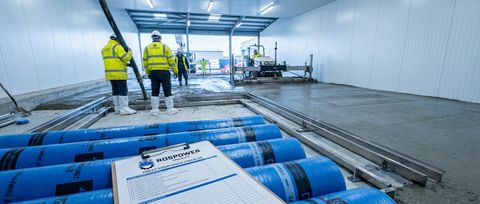
Groundworks for food manufacturing: what makes it different?
Food-grade drainage, BRC-compliant slabs, cold storage foundations, and contamination protocols explained for UK groundworks contractors.
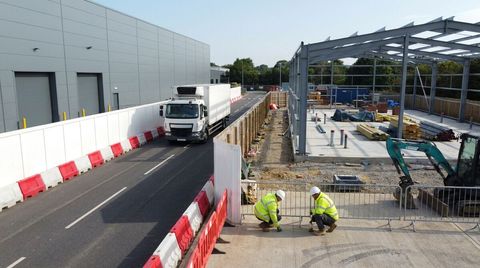
Food factory service tie-ins: prove readiness before shutdown
A practical readiness plan for drainage and utility tie-ins at a live food factory, including isolation, rollback, testing and return to service.
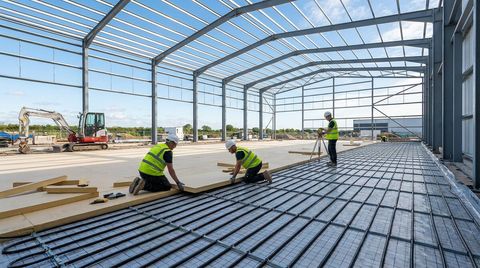
Cold storage foundations: stopping frost heave before it lifts the floor
A frozen store slab held below zero freezes the ground beneath it and heaves. Why cold storage foundations need under-slab heating, not just insulation.