UK drainage gradients & falls
Everything from Approved Document H in one page. Calculate gradients, check bedding specs, and find access point spacing.
Gradient calculator
Enter your pipe details to get the minimum and recommended gradients, plus the fall in millimetres per metre.
Foul vs surface water gradients
Side-by-side comparison. All values from Approved Document H (2015 edition).
| Pipe Diameter | Min. Gradient (1+ WC) | Min. Gradient (no WC) | Practical Self-Cleansing | Fall per Metre |
|---|---|---|---|---|
| 75mm | Not permitted | 1:40 | 1:30 | 25.0mm (at 1:40) |
| 100mm | 1:80 | 1:40 | 1:40 | 12.5mm (at 1:80) |
| 150mm | 1:150 | 1:65 | 1:60 | 6.7mm (at 1:150) |
| 225mm | Hydraulic design required* | Hydraulic design required* | Project specific | Project specific |
| 300mm | Hydraulic design required* | Hydraulic design required* | Project specific | Project specific |
* Approved Document H gives recommended foul drain gradients for 75mm, 100mm and 150mm pipes. Larger foul drains should be designed to the expected flow and site conditions.
Access point spacing
Maximum distances between inspection chambers, manholes, and rodding eyes per Approved Document H.
| Access Type | From | To | Max Distance |
|---|---|---|---|
| Rodding eye | Start of drain | Junction / chamber | 12m |
| Inspection chamber | Rodding eye | Inspection chamber | 22m |
| Inspection chamber | Inspection chamber | Inspection chamber | 45m (straight runs, <150mm) |
| Manhole | Manhole | Manhole | 45m (any pipe size) |
| At changes of direction | Access required at bends and at changes of gradient, with the type of access depending on layout and depth | ||
Approved Document H allows shallow inspection chambers up to 1.2m depth, with deeper chambers using restricted openings. Manholes may still be required depending on depth, diameter, access needs, and the adopted drainage standard. All access points must have a clear opening large enough for drain rods or jetting equipment.
Pipe bedding classes
Bedding and surround details follow BS 9295 and BS EN 1610 (not Approved Document H, which covers gradients and access but not the lettered bedding classes). The class you need depends on pipe material, ground conditions, and traffic loading.
Class S: Full granular surround
Most common for plastic pipes
- • 100mm granular bed below pipe
- • Full 360° granular surround to 300mm above pipe crown
- • Material: 10mm single-size gravel or pea shingle
- • Use for: standard ground, no vehicular loading directly above
Concrete bed and surround
Heavy traffic / poor ground
- • 100mm concrete bed (C20 minimum)
- • 100mm concrete surround all sides
- • Movement joint every 5m to prevent cracking
- • Use for: under roads, car parks, areas with vehicular traffic
Class D: As-dug material
Rarely acceptable
- • Native material used as bedding
- • Only where ground is granular and free of stones >40mm
- • Not permitted in clay, chalk, or made ground
- • Rarely passes building control inspection in practice
Class F: Selected fill bedding
Good for flexible plastic pipes
- • Selected granular material, max particle size 20mm
- • Compacted in 150mm layers around pipe
- • 150mm below invert, 150mm above crown
- • Commonly specified by Polypipe and Wavin for their products
Practical tips from site
The things that aren't in the Building Regs but every experienced groundworker knows.
The 150mm pipe trick for tight gradients
The most common site problem: not enough fall available. A 100mm foul pipe with 1+ WC needs 1:80 (12.5mm per metre). A 150mm pipe only needs 1:150 (6.7mm per metre). Stepping up to 150mm nearly halves the fall you need. On a 20-metre run, that's the difference between needing 250mm of fall versus 134mm. The pipe costs more but the reduced excavation depth usually makes it cheaper overall. This one decision solves the majority of "we can't get the levels to work" situations on site.
Maguire's Rule: the self-cleansing gradient
Divide the pipe diameter by 2.5 to get the practical self-cleansing gradient. So 100mm ÷ 2.5 = 1:40. This isn't in any official document. It's trade knowledge passed down on sites for decades. The Building Regs minimum (1:80 for 100mm) will pass inspection, but 1:40 gives you a gradient steep enough that water flows fast enough to carry solids and keep the pipe clean. If you have the fall available, aim for Maguire's Rule, not the minimum.
The 6-metre plastic pipe problem
LABC warns that inadequate falls in underground pipework are one of the main causes of drainage warranty claims, and highlights bowed 6-metre plastic pipes as a common reason levels go wrong on site. If you lay a bent pipe, you can end up with a backfall in the middle of the run, water pools there, solids accumulate, and blockages follow. The practical fix is to sight along every pipe before laying it and reject any length that is excessively bowed. Check your laser across the full run, not just at the joints.
Checking gradients on site
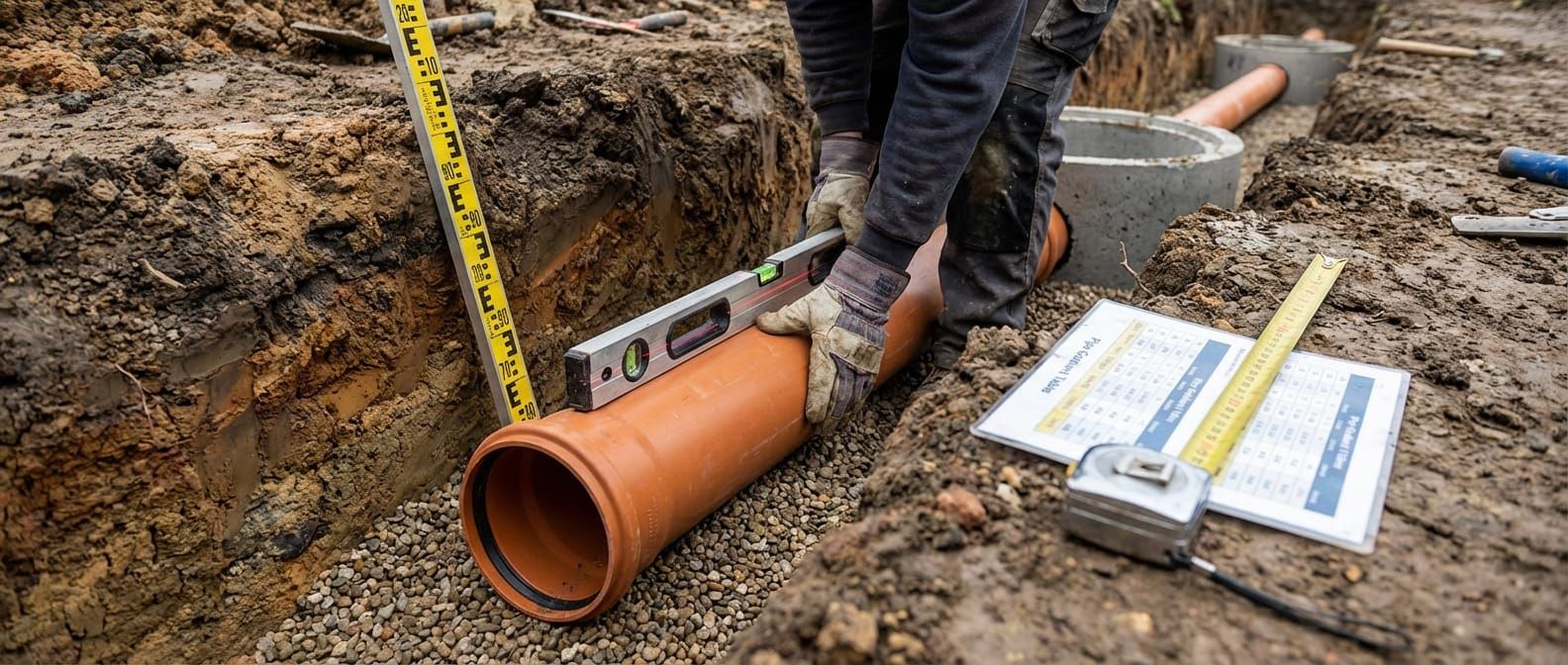
A rotating laser and staff are the standard method, but here's a quick check: for a 1:80 gradient on a 100mm pipe over a 6-metre pipe length, you need 75mm of fall between pipe joints (6000 ÷ 80 = 75mm). Mark 75mm on your spirit level with tape. Place the level on the pipe; when the bubble is centred with the 75mm end lifted, you're at 1:80. Not a substitute for a laser, but useful for a quick sanity check before the next pipe goes in.
Sources
- Approved Document H: Drainage and waste disposal (HM Government, 2015 edition)
- LABC (Local Authority Building Control) technical guidance on drainage installation
- BS EN 1610:2015 Construction and testing of drains and sewers
- Polypipe, Wavin, JDP manufacturer installation guides
Built by Rospower Projects, a specialist groundworks and civil engineering contractor. 35+ years on site.
Discuss your projectRelated resources
Aggregate & MOT Type 1 tonnage calculator
Work out the tonnage of MOT Type 1, sub-base, capping, sand, gravel, or topsoil by area and depth, with typical UK bulk densities, bulk-bag, and tipper-load counts.
Concrete specification quick reference for site
Application selector, exposure classes, cover depths, reinforcement weights, and slump guidance. Everything from BS 8500 that a site agent needs on one page.
Concrete volume calculator & mix selector
Work out concrete volume by shape, get an indicative BS 8500 strength class, a wastage allowance, and a ready-mix truck count for a UK pour.