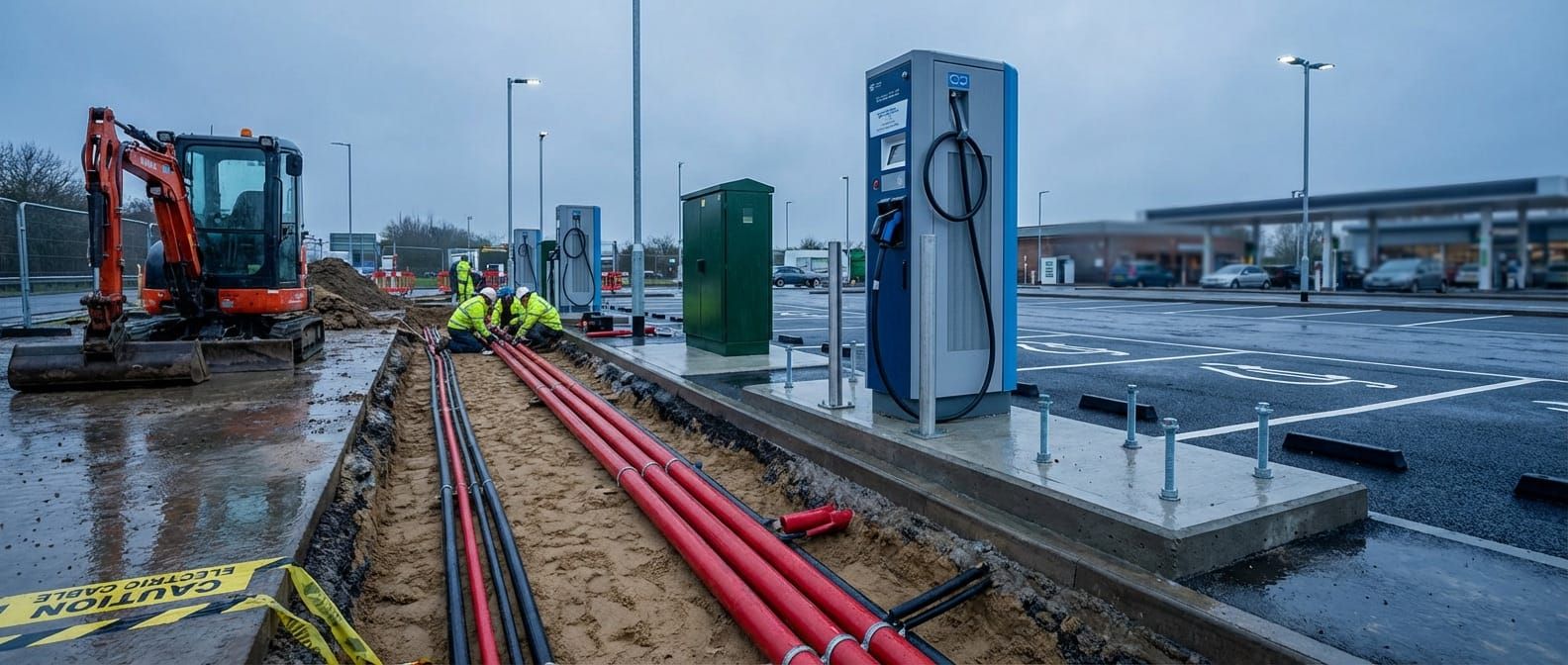
EV charging infrastructure civil works guide
What civil engineering is involved at each charger power tier. Cable specs, substation thresholds, groundworks scope, and DNO connection timelines for UK installations.
UK EV infrastructure: 2026 outlook
- • DfT's latest quarterly release reports public EV chargers, not just charging devices, and is correct as of 1 January 2026
- • DfT power bands classify 50kW to less than 150kW as rapid, and 150kW and above as ultra-rapid
- • Rapid and ultra-rapid chargers together account for about 22% of public EV chargers in the January 2026 release
- • MW-class charging for heavy-duty fleets should be treated like an industrial HV connection project, not a car park retrofit
- • Civil engineering scope increases dramatically above 50kW
Source: DfT public EV charging infrastructure statistics, January 2026
Charger tier scope calculator
Select a charger power tier, number of charge points, and site type to see the civil engineering scope.
Power supply
Cable and ducting
Groundworks scope
Civil works complexity
Site layout reference dimensions
Typical space requirements for different hub sizes. Use as a starting point for feasibility assessments.
Small hub (4x 50kW)
Site area and bays
- • Minimum site area: ~200m² (parking bays + access)
- • Bay width: 2.7m standard, 3.6m accessible
- • Bay depth: 5.0m (car), 6.0m (with overhang space)
- • Aisle width: 6.0m minimum for two-way traffic
Infrastructure
- • Feeder pillar/switchgear compound: ~4m x 2m
- • Cable run from pillar to furthest bay: typically 20-40m
Medium hub (8x 150kW)
Site area and layout
- • Minimum site area: ~600m² (bays + island canopy + access)
- • Separate pedestrian access if canopy provided
Infrastructure
- • Substation compound: ~6m x 4m minimum (consult DNO)
- • HV cable route from boundary: varies by site
Large hub (12x 350kW or HGV depot)
Site area and access
- • Minimum site area: 1,200m²+ for cars, 2,500m²+ for HGVs
- • HGV turning circle: 20m minimum diameter
- • Separate car and HGV access preferred
Infrastructure
- • Substation: 8m x 6m+ (11kV or 33kV)
- • Drainage design for large hardstanding area (SuDS may be required)
Utility duct specification reference
Standard UK duct colours and separation distances based on NJUG Volume 1 guidelines. Always confirm with the local DNO and utility providers for site-specific requirements.
| Utility | Duct colour | Minimum depth | Min. separation from other ducts |
|---|---|---|---|
| Electricity (LV) | Black | 450mm (footpath), 600mm (road) | 100mm from comms |
| Electricity (HV) | Red | 750mm (footpath), 900mm (road) | 300mm from LV, 600mm from gas |
| Gas | Yellow | 450mm (footpath), 600mm (road) | 600mm from electricity |
| Water | Blue | 750mm minimum | 350mm from other services |
| Telecoms / data | Green or grey | 350mm (footpath), 450mm (road) | 100mm from electricity |
| EV charging feeder | Black (marked) | 600mm typical | As per LV/HV depending on voltage |
Regulatory and delivery checklist
Tick off each item as you confirm it for your project. Expand any item for more detail.
Planning and permissions
DNO and power supply
Civil engineering and groundworks
Accessibility and compliance
Practical notes
Things to keep in mind when planning EV charging civil works.
DNO timelines are indicative
Actual timelines depend on existing network capacity, required reinforcement, and DNO workload. In areas where the distribution network is already at capacity, reinforcement works can add 6-12 months to the programme. Request a budget estimate as early as possible.
Early DNO engagement for HV sites
For sites requiring HV connections (typically 150kW+ hubs), early engagement with the DNO is essential. Budget estimates are free and non-committal. They give you the information needed to make a business case before committing to detailed design. Some ICPs (Independent Connection Providers) can also provide competitive quotes for the connection works.
OZEV grant schemes
OZEV workplace and on-street grant schemes have specific technical requirements that may affect civil works scope. Eligible installations must meet particular power output, accessibility, and data-sharing criteria. Check GOV.UK OZEV grants for current eligibility and requirements before finalising your civil design.
PAS 1899:2022 accessibility standards
PAS 1899:2022 sets accessibility standards for public EV charging. If installing public chargers, the civil works (bay sizes, gradients, surface finishes, kerb detailing) must accommodate these requirements from the design stage. Retrofitting accessibility after installation is significantly more expensive than getting it right first time.
Sources
Built by Rospower Projects. We deliver civil engineering for EV charging infrastructure, renewable energy, and utility connections across the UK.
Discuss your projectRelated resources
CITB levy & grants guide for groundworks contractors
Interactive decision flow for registration, levy calculation, and grant claims under the January 2026 restructure. Worked examples for small firms.
CSCS cards for groundworkers
Visual pathway guide from no card to Gold Supervisor. Costs, timelines, NVQ routes, plant cards, and the June 2026 EUSR changes explained.
Data centre site readiness checker
Interactive pre-design checker for UK data centre and AI infrastructure sites, covering power, water, planning, access, groundworks, drainage, and resilience evidence.