Why solar projects aren't starting: the NESO grid connection queue in 2026
RWE walked away from a 99.9MW Welsh solar project this April over grid connection availability. The NESO connection queue is reshaping which UK solar and storage projects actually get built in 2026.
By Connor Lyons, Commercial director
Generated by your browser's built-in AI. May not be fully accurate.
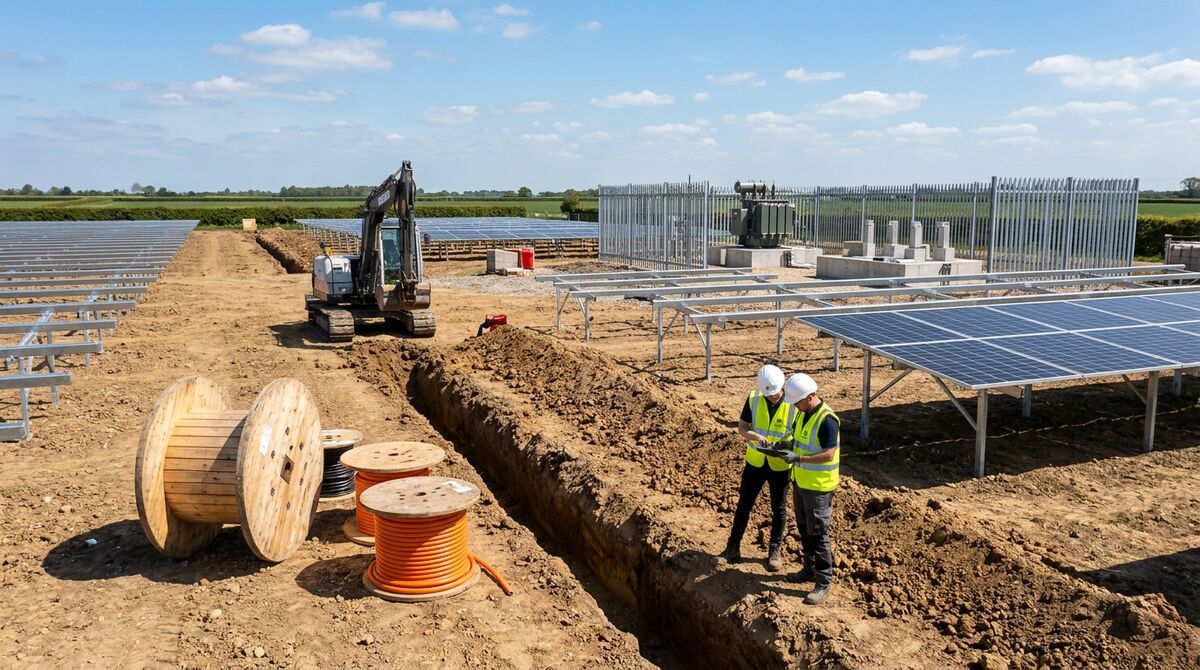
On 15 April 2026, RWE announced it was dropping the Butterfly solar-plus-storage project near Wrexham. 99.9MW of generation and battery storage, three parcels of agricultural land, an underground cable route to a National Grid substation. The project had been in development for years.
The reason wasn’t planning. It wasn’t yield. It wasn’t community opposition. RWE said grid connection availability made it unviable at this stage, and that some projects in the queue now face timelines extending into the early-to-mid 2030s.
That is the headline a developer can be honest about in public. The harder version is that the National Energy System Operator’s connection queue, and the reform programme designed to clear it, is now the binding constraint on UK solar and battery storage delivery. Not money. Not policy. Not consenting. The grid.
For civil engineering contractors with order books exposed to renewable energy, the timing of any individual project is now a function of NESO’s offer cycle, the transmission operators’ build programmes, and Ofgem’s enforcement appetite. None of those things are inside the developer’s control, and most of them are not inside NESO’s control either.
This is what’s actually happening, what got delayed in the last quarter, and what it means for projects that have already been priced.
The queue, in numbers NESO publishes itself
The Connections Reform programme started because the queue had become unmanageable.
NESO’s own framing: the queue at the start of reform was “around four times what’s needed for 2030 and double 2050,” sitting at over 700GW of generation and storage applications. Developers were essentially holding placeholders against connection capacity that didn’t exist and might never be built, while genuinely viable projects sat behind them. The first-come, first-served system had been gamed past breaking point.
Source: NESO Connections Reform overview
The reform output, as NESO presents it, is more orderly. The Gate 2 process has identified projects that meet readiness criteria. NESO claims this has unlocked:
- 283GW of generation and storage capacity at Gate 2
- 99GW of transmission-connected demand
- 132GW aligned with the government’s Clean Power 2030 target
- Up to £40bn a year in potential investment
Source: NESO press release on grid connection reforms
Those numbers are the case for reform. The case against: between January and June 2025, applications surged by 460%, with delays to individual offers stretching to as much as 15 years for some classes of project. The queue is more orderly than it was, but the throughput problem hasn’t gone away. Applications have been received, sorted, and reprioritised. Connections themselves still need to be built, and that requires transmission operators to physically construct substations, cables, and reinforcement that don’t exist yet.
What got pushed in the last quarter
In February 2026, NESO confirmed another round of timetable slippage. Two distinct effects: the projects that had already secured “protected” status (and were therefore expecting to keep their original 2026/27 connection dates) saw their offer windows pushed back, and the wider Gate 2 cohort had its phased offer schedule extended.
The published offer windows now sit roughly as follows:
| Cohort | Offer window |
|---|---|
| Protected transmission and large-embedded (2026/27 connection) | 13 February – mid-April 2026 |
| Protected distribution | Early March – end of May 2026 |
| Gate 2 Phase 1 transmission and large-embedded (pre-2030) | Mid-May – mid-September 2026 |
| Gate 2 Phase 1 distribution | Mid-July – mid-November 2026 |
| Gate 2 Phase 2 transmission and large-embedded (2030–2035) | Early September 2026 – mid-January 2027 |
| Gate 2 Phase 2 distribution | Mid-October 2026 – mid-March 2027 |
Source: Solar Power Portal on grid connection offer delays (18 February 2026)
NESO also removed reference to when the next application window will open. For developers waiting for a Gate 2 slot rather than a Gate 2 offer, the calendar now ends without a defined next step.
The protected cohort is the one to watch. These are projects that NESO and the transmission operators had identified as already meeting the criteria to keep their original 2026/27 connection dates through the transition. They were the developers who, on paper, had nothing to worry about. In practice, 62% of them are now expected to miss those dates: 210 out of 340 qualifying projects, on Ofgem’s published figures from 11 February 2026.
Ofgem’s response, and why it matters
Ofgem’s published statement on the protected-cohort delays was unusually direct for a regulator. It said it was “both frustrated and disappointed that it is not possible for TOs and NESO to meet existing connection dates and points of connection for all projects qualifying for this Protection,” and confirmed that “at this time, no relief from NESO/TO obligations in relation to the connection offers for these affected Protected Projects will be granted.”
Source: Ofgem cited via Solar Power Portal
In regulatory terms, “no relief” means Ofgem is not letting NESO and the TOs off the hook for the missed dates. The obligation to deliver the connection on the original timetable still stands, even though the connection clearly isn’t going to be delivered on that timetable. Instead, Ofgem directed transmission operators and NESO to offer affected developers “their best view of the most ambitious date possible.”
The practical effect for developers is that the 2026/27 connection date in their original offer is now closer to a fiction than a commitment. The replacement date, when it arrives, will be the actual one to plan against. For projects that priced finance, EPC contracts, and PPAs around the original date, that is a non-trivial event. For civil engineering contractors who priced enabling works around the same date, it has the same effect: mobilisation slips, sometimes by a year or more.
Why the protected cohort still slipped
The honest reading of the protected delays is that they are a build problem, not a paperwork problem.
A grid connection isn’t a piece of correspondence. For most utility-scale solar and storage projects, it is a physical asset that the relevant transmission operator (National Grid in England and Wales, SP Transmission in southern Scotland, SSEN Transmission in northern Scotland) has to build. New substations, reinforcement of existing substations, transformer installations, sometimes new circuits over many kilometres, sometimes statutory undergrounding through environmentally sensitive land. Each of these requires its own consenting, procurement, supply chain (long-lead transformers and switchgear are constrained globally), and construction programme. None of it goes faster because Ofgem is annoyed.
The 62% slippage in the protected cohort is mostly the TOs telling NESO that the works to deliver those connections cannot, in fact, be completed by the contracted dates. That is information NESO needs to pass on to developers, and it has. The question for the rest of 2026 is whether the build pace catches up with the queue order, or whether the slippage compounds.
What it means if you’re a civil engineering contractor
If your business has solar farm groundworks, BESS compound construction, cable route civils, or substation enabling works in the order book, the practical consequences come in three shapes.
Project starts move right, sometimes by a long way
A consented solar farm with a 2026/27 connection date in the original offer may now be looking at 2027/28 or later. The civil engineering programme for a project of that scale typically starts 12 to 18 months before energisation. Some packages (early access track works, ground investigation, ecological mitigation in advance of seasonal restrictions) start earlier still. When the connection date moves, the start date for civils moves with it, and the gap is usually larger than the headline because nobody wants to mobilise too early and risk the works lying idle if the connection slips again.
For contractors with capacity already allocated, this is a planning problem. Plant, labour, and supervisor time pencilled in for Q3 2026 may now be needed in Q3 2027. The gap has to be filled with other work, and the deferred work has to be re-priced if costs have moved. We’ve seen quotes from late 2025 that no longer reflect current rates by a margin that wipes out the margin.
Mobilisation triggers should reference the connection, not the calendar
Subcontract terms that fix mobilisation dates against a calendar quarter are no longer reliable. The defensible structure now ties mobilisation to defined milestones: e.g., “the earlier of (i) energisation date confirmed in writing by the transmission operator, or (ii) X weeks after the principal contractor issues notice to commence.” That gives the developer the optionality they need (because the connection is genuinely outside their control) without leaving the subcontractor exposed to indefinite hold periods on plant and labour.
If you’re being asked to commit to a calendar-based start date on a project whose connection date is in the protected cohort or behind a Gate 2 Phase 2 offer window, that risk needs pricing. A simple test: ask the developer to share their NESO offer letter and the transmission operator’s most recent build programme update. If they can’t, or won’t, the calendar date in the contract is informed by the original offer, not by the actual delivery position.
Battery storage timing has its own profile
Storage projects are particularly exposed. Many BESS projects are coming forward as pure storage, without co-located generation, and rely entirely on grid services revenue. Their viability is more sensitive to connection date than a generation project, because storage revenues depend on market conditions in a specific year (capacity market clearing prices, ancillary services contracts, BM revenues). A two-year delay can move a project from a year with a strong capacity market signal to one without.
For civil engineering contractors, this means BESS compound packages are more likely to be deferred or cancelled outright than equivalent solar packages, even where the planning consent is identical. Pricing should reflect that. The civils scope on a 50MW BESS is largely concrete pads, drainage, fire-water containment, fencing, and cable trenching. None of it is recoverable if the project doesn’t go ahead, but the design fees and pre-mobilisation costs are already sunk by the time the developer makes the call. Cap your pre-construction exposure carefully.
The £28bn network investment isn’t a fix in 2026
Ofgem’s £28bn network investment programme, with the potential to extend to £90bn over five years to 2031, is the policy answer to the queue problem. New substations, new circuits, reinforcement of existing capacity. It is real funding behind committed projects, and over time it does shorten connection timelines.
For civil engineering contractors, that is a separate pipeline of work. Substation civils, cable routes, joint bays, compound construction. The procurement runs through transmission operators and DNOs, typically via Tier 1 framework partners. For contractors with NERS and adoptable utility infrastructure capability, that pipeline is growing.
But it is not the solution to a 2026 mobilisation gap. The reinforcement works enabling, say, a new 132kV connection in the Midlands take years to consent and build. They will help projects in the queue today, but they are unlikely to bring forward a 2027/28 connection to a 2026/27 connection. The Gate 2 reordering is doing what it can with the existing physical network. The new physical network is the next phase.
This is worth holding in mind when reading optimistic policy briefings about “unlocking” capacity. The 283GW figure NESO publishes is generation that has been allowed back into a sensible queue. It is not generation that has been connected. The two are separated by a build programme that the transmission operators are still procuring and constructing, and that build programme is itself constrained by transformer and switchgear lead times, consenting timelines, and skilled labour availability.
What we tell clients now
We work for solar developers, energy companies, and EPC contractors across the renewable energy pipeline. The conversation with each of them now starts with a question about connection status before it gets to a price.
A few things are worth saying directly to anyone procuring civil engineering on a renewable project in 2026:
- The connection offer is more important than the planning consent for programme certainty. Both matter. But planning consent doesn’t move once it’s granted. Connection dates do, and they are now the most likely source of programme slippage.
- Index-linked rates are not optional on long-tail projects. A connection date that slips from 2026/27 to 2027/28 means a year of cost inflation between quotation and mobilisation. If your subcontract is fixed-price across that gap, somebody is taking a hit. Better to agree the indexation up front.
- Pre-construction exposure should be capped. Design coordination fees, ecological surveys, advance access works: these can build up over a year of delay. If the project doesn’t proceed, the costs are stranded. Cap them at a defined value with clear triggers for when the developer decides to either commit or release.
- Watch the protected-cohort signal. If your project is in the protected cohort and Ofgem’s published figures show 62% slippage, assume your project is one of the 62% until the developer can show you written confirmation of an updated, achievable date from the TO. Plan the civil engineering programme on the realistic date, not the original offer.
This isn’t pessimism. The pipeline is still substantial. NESO has cleared a path to 283GW of better-prioritised capacity. The £28bn network investment is funded. The Clean Power 2030 target is policy. There is a lot of work coming. It just isn’t all coming on the dates that the original connection offers said it would, and contractors who plan around the original dates are going to find themselves with mobilisation gaps that nobody is paying for.
We’ve spent the last three years building our renewable energy and utility infrastructure capability, and our order book reflects where the work actually lands rather than where it was originally programmed to land. If you’re a developer, EPC contractor, or main contractor with a project navigating the Gate 2 or protected-cohort timetable, get in touch. We can talk through what the connection-date risk means for your civil engineering programme, and how to structure the package so the risk sits with whoever is best placed to manage it.
Connor Lyons is commercial director at Rospower Projects. We deliver groundworks, cable trenching, and substation civils on UK renewable energy and utility infrastructure projects, with NERS accreditation for adoptable electrical infrastructure. For pipeline, capacity, or pricing conversations, contact our commercial team.
Sources and further reading
- RWE drops 99.9MW solar project in Wales on grid constraints (PV Magazine, 15 April 2026)
- Grid connection offers delayed again as impact on UK developers grows (Solar Power Portal, 18 February 2026)
- Ofgem frustrated with delays to 62% of Gate 2 project connections (Solar Power Portal, 11 February 2026)
- NESO implements electricity grid connection reforms (NESO press release)
- NESO Connections Reform overview (NESO)
- Ofgem unlocks £28bn investment in energy grid (Ofgem)
- Clean Power 2030 metrics (GOV.UK)
Related articles

Recycled aggregate: evidence to check before use
Check the product, intended use, delivery record and waste-status evidence for recycled aggregate before it is accepted into a groundworks package.

UK construction events 2027: dates confirmed
Confirmed 2027 UK construction, plant, utilities, energy and food manufacturing events, plus major calendars still awaiting dates as of August 2026.
Civils starts jump 34% while the wider market stalls
Glenigan's August index shows civils starts up 34% on the quarter while overall starts fell 11%. What the summer 2026 data means for clients planning work.